Heat bank design: Difference between revisions
Jump to navigation
Jump to search
Ehrennagel (talk | contribs) No edit summary |
Ehrennagel (talk | contribs) |
||
| Line 5: | Line 5: | ||
http://wiki.cs.earlham.edu/images/0/06/Heat_Exchanger_Schematic.GIF | http://wiki.cs.earlham.edu/images/0/06/Heat_Exchanger_Schematic.GIF | ||
By nesting two copper coils in this way we can fit over 80 feet of 3/4" pipe into a 2 ft. cube. The outer coil will have a diameter of 2 ft. with 8 loops giving us 2*3.14*8 = 50.24 ft. of pipe. The inner coil will have a diameter of 1.5 ft. also with 8 loops giving us 1.5*3.14*8 = 37.68 ft of pipe. Our [http://wiki.cs.earlham.edu/index.php/Heat_exchanger_modeling calculations] indicate that this will provide us with a significant increase in the temperature of the main water before it enters the electric hot water heater. | By nesting two copper coils in this way we can fit over 80 feet of 3/4" pipe into a 2 ft. cube. The outer coil will have a diameter of 2 ft. with 8 loops giving us 2*3.14*8 = 50.24 ft. of pipe. The inner coil will have a diameter of 1.5 ft. also with 8 loops giving us 1.5*3.14*8 = 37.68 ft of pipe, for a total of 87.92 ft. Our [http://wiki.cs.earlham.edu/index.php/Heat_exchanger_modeling calculations] indicate that this will provide us with a significant increase in the temperature of the main water before it enters the electric hot water heater. | ||
Revision as of 03:27, 29 September 2006
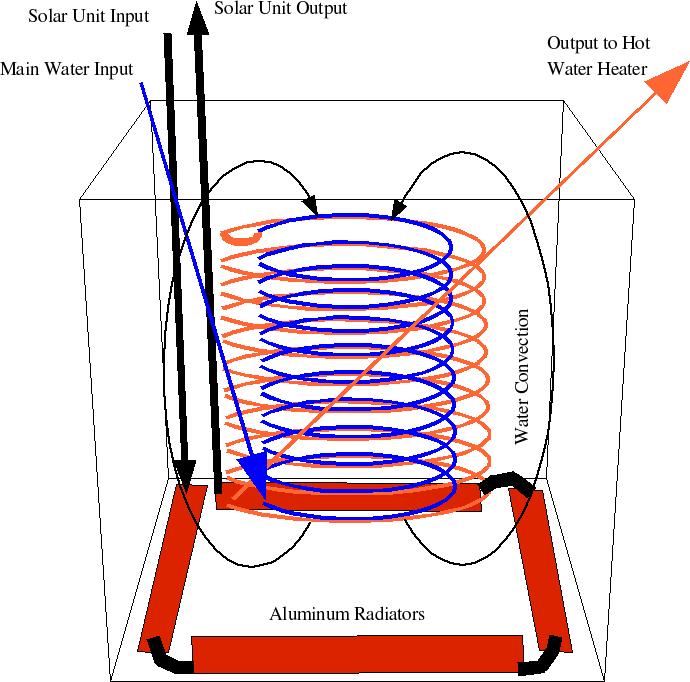
Heat Bank Concept Sheet
http://wiki.cs.earlham.edu/images/6/67/Heat_bank.jpg
Copper Coil Schematic
http://wiki.cs.earlham.edu/images/0/06/Heat_Exchanger_Schematic.GIF
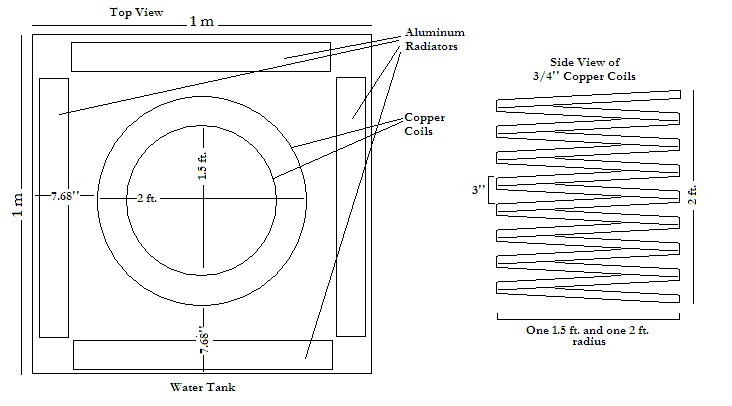
By nesting two copper coils in this way we can fit over 80 feet of 3/4" pipe into a 2 ft. cube. The outer coil will have a diameter of 2 ft. with 8 loops giving us 2*3.14*8 = 50.24 ft. of pipe. The inner coil will have a diameter of 1.5 ft. also with 8 loops giving us 1.5*3.14*8 = 37.68 ft of pipe, for a total of 87.92 ft. Our calculations indicate that this will provide us with a significant increase in the temperature of the main water before it enters the electric hot water heater.